
Nipponopelta Yezoensis: 7 Remarkable Facts from Japan
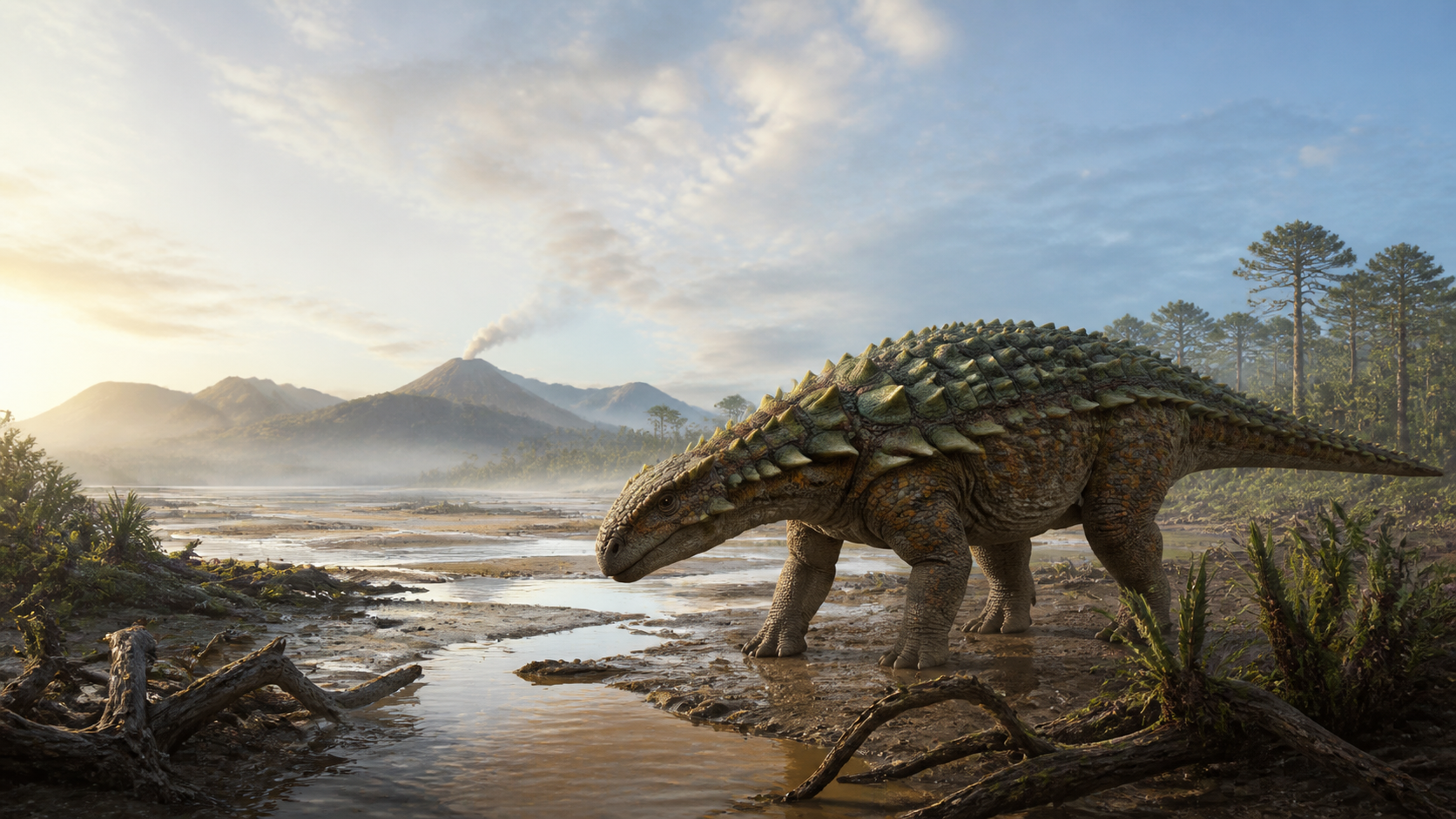
Nipponopelta yezoensis is the first ankylosaur formally described from Japan. The new species was identified from material discovered in Hokkaido, where it lived about 96 to 94 million years ago during the Late Cretaceous. Its name adds an important Japanese chapter to the history of armored dinosaurs in Asia.
The discovery is valuable because the specimens preserve more than an isolated clue. Researchers revisited a partial skull, a cranial vertebra, and several teeth from the Hikagenosawa Formation in Yubari. Three-dimensional CT scanning then revealed hidden structures, including part of the lower jaw, two intact teeth, and the left inner ear.
This guide explains what Nipponopelta yezoensis tells us about Japan’s Cretaceous ecosystems, how the animal fits within nodosaurid evolution, and why a coastal habitat may have helped its relatives spread across ancient continents. The evidence comes from the reported study and the scientific news summary linked in the sources below.
Table of contents
1. What do Hokkaido dinosaur fossils reveal?
The fossils assigned to Nipponopelta yezoensis came from the upper part of the Hikagenosawa Formation near Yubari, on Japan’s northern island of Hokkaido. The material was found in a concretion during the 2000s. A concretion is a hardened mineral-rich mass that can protect delicate fossil material, although it can also make preparation and identification difficult.
The original discovery was recognized as belonging to a nodosaurid ankylosaur, but its exact taxonomic status remained unresolved. In other words, researchers knew the material represented an armored dinosaur, yet the available features were not enough to establish a new genus and species with confidence.
That changed when Shumpei Oyabu and colleagues from Japan, Canada, and the United States returned to the specimens. Their study combined traditional anatomical comparison with digital imaging and evolutionary analysis. The result was the formal naming of Nipponopelta yezoensis as a new nodosaurid ankylosaur.
The find is not a complete individual and does not provide a full-body measurement. That distinction matters. A scientific name can be securely established from a limited part of an animal when the preserved features form a distinctive combination, but the missing parts should not be reconstructed as if they were directly observed.
There is also a practical lesson in the way the discovery was reported. A fossil locality is more than a point on a map: its rock layer supplies age, sedimentary setting, and the environmental context needed to interpret the animal. When those lines of evidence are considered together, the specimen becomes useful for both taxonomy and Earth history.
The Japanese record is especially important because island and coastal deposits can preserve a different sample from inland formations. Shoreline sediments may capture animals living close to water, while the same rocks can also be affected by transport, reworking, and changes in sea level. Researchers must therefore compare anatomy with geology instead of treating location alone as proof of lifestyle.
Every new named species also improves the vocabulary used in later studies. Once a distinctive combination of features has been documented, other specimens can be compared against it. A future find from Japan, China, or another ancient coastal region may confirm the pattern, refine it, or show that several related animals were present.
That process is slower than a headline suggests, but it is one reason formal descriptions remain valuable. The name provides a stable point for discussion, while the evidence behind the name can continue to be tested. In paleontology, a careful first description is often the beginning of a research program rather than the final word.
2. Why does this Japanese ankylosaur matter?
Nipponopelta yezoensis is the first ankylosaur formally described from Japan. That statement refers to a scientific description and name, not to the first armored dinosaur evidence ever found in the country. Earlier material may have suggested ankylosaurs, but a formal species description requires enough diagnostic information to support a clear taxonomic case.
Japan’s position during the Cretaceous makes the discovery especially useful. The islands and their surrounding regions were part of a changing, marine-influenced world, and the geography was not identical to the modern Japanese archipelago. Fossils from these rocks record animals living along shores, floodplains, and estuarine settings.
The broader Asian record of nodosaurids is comparatively small when set beside the extensive North American and European record. Each well-described Asian specimen therefore carries unusual weight. Nipponopelta yezoensis gives researchers a better anchor for testing whether Asian nodosaurids formed a single regional branch or arrived through several dispersal events.
The species also shows why fossil discoveries can remain scientifically important years after excavation. The Hokkaido material was collected more than two decades ago, but improved imaging and renewed comparison made it possible to extract information that was not obvious at first. New technology often changes the value of an old specimen without changing the specimen itself.
3. What did CT scanning reveal?
Three-dimensional CT scanning allowed the researchers to inspect hidden structures without physically exposing every surface. This is particularly useful when a fossil is enclosed in hard rock or when preparation could damage a fragile feature. Digital slices can be combined into a model that makes internal and obscured anatomy easier to compare.
For Nipponopelta yezoensis, the scans revealed a section of the lower jaw, two intact teeth, and the animal’s left inner ear. These features expanded the anatomical dataset available for classification. They also helped researchers evaluate the combination of traits at the back of the skull, which was described as distinctive.
The inner ear is not simply a decorative detail in a scientific description. Its shape can contribute to comparisons among related dinosaurs, although one isolated structure should never be treated as a complete explanation of behavior. The safest conclusion is that the newly visible anatomy improved the quality of the evolutionary analysis.
CT work also illustrates a central principle of paleontology: fossils are evidence, not photographs of the past. Every conclusion depends on preservation, preparation, comparison, and the limits of the available sample. In this case, digital imaging made previously hidden evidence available for testing rather than turning an incomplete specimen into a complete one.
4. Where does Nipponopelta yezoensis fit among nodosaurids?
Ankylosaurs are traditionally divided into two major groups: nodosaurids and ankylosaurids. Both groups are known for heavily built bodies and protective armor, but they are not the same branch of the dinosaur family tree. Nipponopelta yezoensis belongs to the nodosaurid side of that division.
The study’s phylogenetic analysis placed Nipponopelta yezoensis among derived nodosaurids associated with North America and Europe. The comparison included genera such as Pawpawsaurus, Panoplosaurus, Edmontonia, and Denversaurus. This result was notable because the Japanese species was not grouped most closely with the small number of previously described Asian nodosaurids.
“Derived” in this context means a later-evolving or more specialized position within the analyzed family tree. It does not mean that one animal was superior to another. A phylogenetic placement is a hypothesis built from shared anatomical features, and the result can be refined as new specimens and characters become available.
The placement creates a useful geographic question. If Nipponopelta yezoensis is nested with distant North American and European forms, researchers must investigate whether related populations crossed ancient land connections, followed coastal corridors, or reflect an older distribution that has been poorly sampled in Asia.
That is why the species matters beyond its name. It is not only a new dinosaur from Japan; it is also a test case for how paleontologists reconstruct relationships when geography, incomplete preservation, and uneven fossil sampling all interact.
5. What was its coastal habitat like?
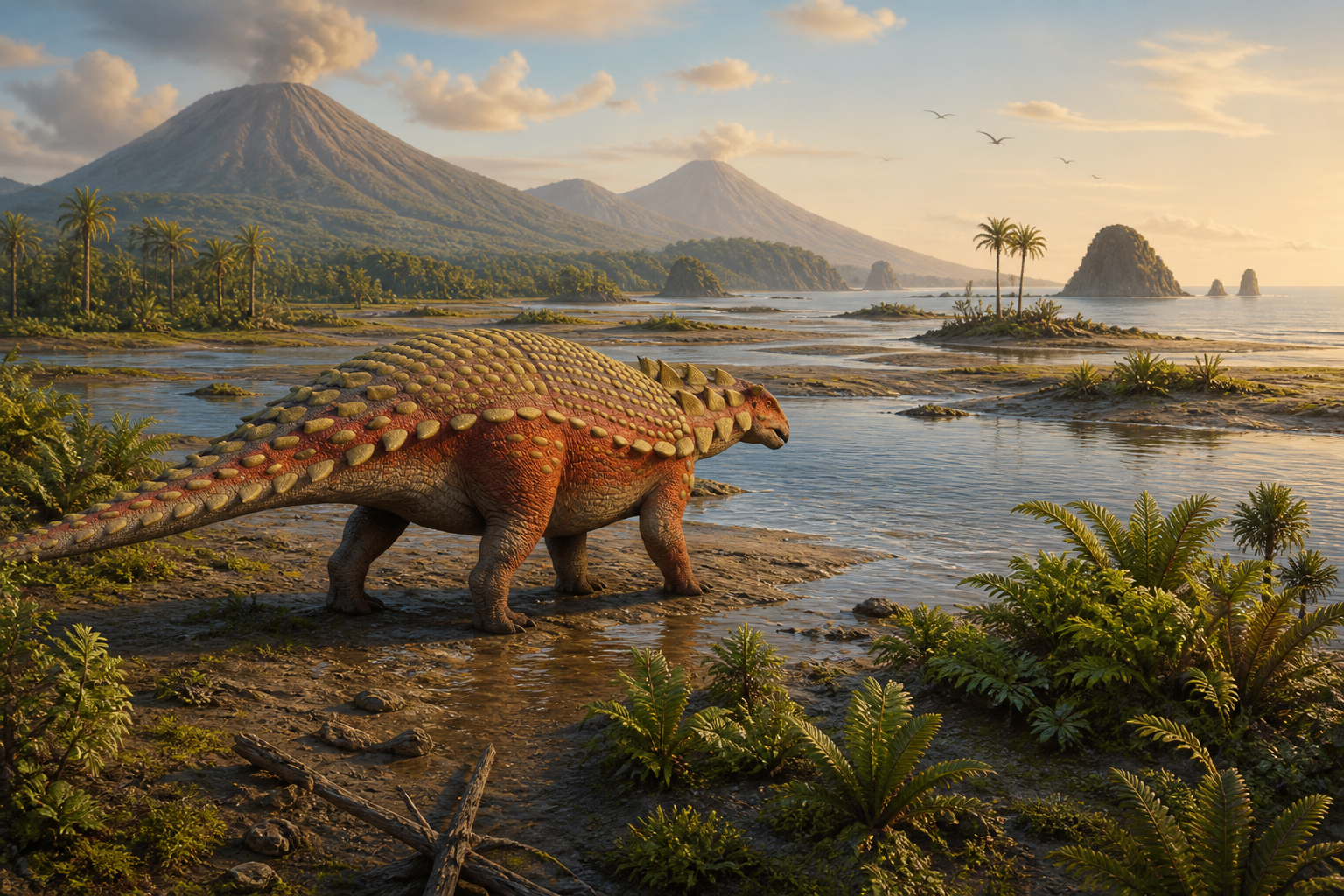
Habitat reconstruction in the study suggests that Nipponopelta yezoensis preferred marine-influenced environments, probably including coastal or estuarine areas. An estuary is a zone where river water mixes with seawater. Such settings can contain shifting channels, mudflats, low vegetation, tidal influence, and changing salinity.
The reconstruction does not mean that every individual spent its entire life standing in seawater. “Marine-influenced” is a broader environmental description. It points to a landscape shaped by nearby seas, coastal sedimentation, or brackish waterways, while leaving room for animals to use adjacent floodplains and terrestrial ground.
Nodosaurids are more commonly associated with marine deposits than ankylosaurids. That pattern may reflect genuine habitat preference, preservation bias, or both. Coastal sediments can bury remains efficiently, while the fossil record is also influenced by where researchers have searched and which rocks remain exposed.
Even with those cautions, the coastal signal helps explain the evolutionary discussion around Nipponopelta yezoensis. If nodosaurids repeatedly occupied shore-adjacent settings, coastlines could have served as recurring ecological routes. The habitat would not have been an open ocean highway, but it could have connected suitable environments across changing regions.
The setting also gives the animal a more realistic identity. A dinosaur should not be imagined only as a museum mount or a name on a family tree. Its living world included wet ground, plant communities, water channels, weather, and neighboring animals. The environmental evidence helps place Nipponopelta yezoensis inside that larger Cretaceous system.
6. What does it say about dinosaur dispersal?
The researchers used ancestral geographic analysis to investigate how the lineage may have been distributed through time. Their model suggested a broad ancestral area involving Laramidia, Appalachia, and Asia. These names refer to ancient geographic regions, not modern countries, and they describe a world whose coastlines and land connections differed greatly from today.
The result does not provide a single recorded migration route. Instead, it identifies geographic scenarios that are compatible with the evolutionary tree and the known distribution of related animals. Such models are valuable because they turn a pattern in the fossil record into a question that can be tested with additional discoveries.
For Nipponopelta yezoensis, the key implication is that the Japanese species may be part of a wider history of nodosaurid movement. The combination of its phylogenetic position and its marine-influenced habitat makes dispersal along connected coastal environments one reasonable line of investigation.
Ancient geography was dynamic. Sea levels rose and fell, volcanic arcs shifted, basins opened and closed, and animal populations were separated or reunited. A coastal species could therefore encounter changing opportunities without needing to travel across a modern-style continent map.
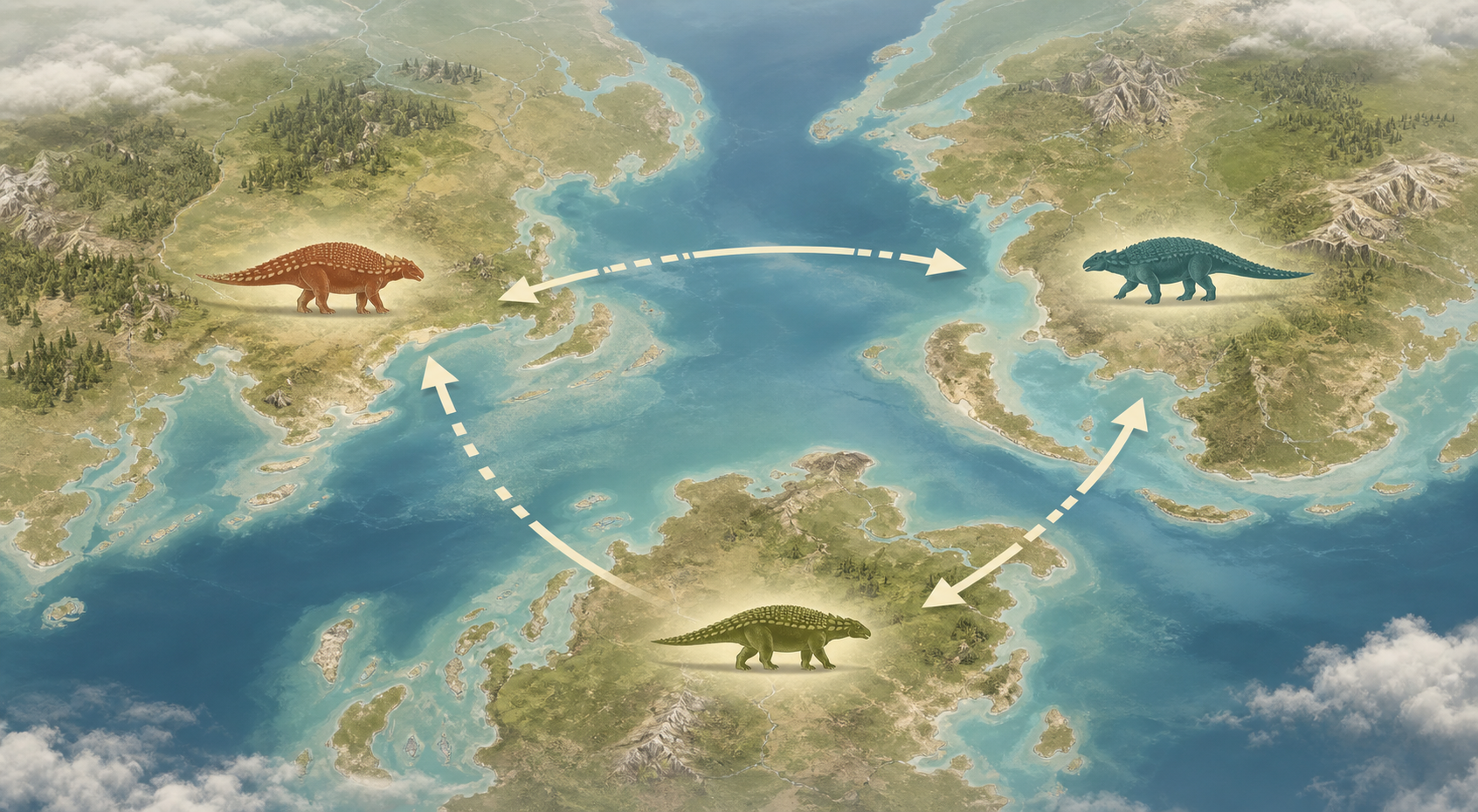
This is where the discovery becomes part of a global story. A fossil from Hokkaido can help evaluate relationships that include animals from North America and Europe. Nipponopelta yezoensis links local geology with questions about continental history, ecological tolerance, and the uneven way dinosaur lineages appear in the fossil record.
7. What remains uncertain?
Several important details about Nipponopelta yezoensis remain unknown. The available material does not establish a complete body length, exact body mass, precise diet, or the full appearance of its armor. Those details may be estimated in a future reconstruction, but they should be labeled as estimates rather than reported measurements.
The fossils also do not tell us exactly how the animal behaved at the water’s edge. A coastal setting can support many lifestyles. Nipponopelta yezoensis may have moved through nearby wetlands and estuaries, but the source does not justify claims that it was fully aquatic, an expert swimmer, or a specialized marine animal.
Its evolutionary placement may also change with new discoveries. Phylogenetic trees depend on the character matrix, the taxa included, and the quality of each specimen. A future nodosaurid from Asia could add features that alter relationships or clarify whether the Japanese branch represents a wider regional history.
These limits do not weaken the discovery. They define the next questions. A strong fossil study separates what was directly observed from what was inferred, and Nipponopelta yezoensis offers a clear example of how partial evidence can produce meaningful, testable conclusions.
Frequently asked questions about Nipponopelta yezoensis
What does the name Nipponopelta yezoensis mean?
The name combines a reference to Japan with “pelta,” a term associated with a small shield, and “yezoensis,” a reference to Yezo, an older name used for Hokkaido. The exact naming explanation belongs to the formal scientific paper, but the name clearly connects the species with its Japanese discovery locality.
When did Nipponopelta yezoensis live?
Nipponopelta yezoensis lived during the Late Cretaceous, approximately 96 to 94 million years ago. This interval predates the final Cretaceous extinction by many millions of years and represents a time when shorelines, volcanic regions, and dinosaur communities were undergoing major geographic change.
Where was Nipponopelta yezoensis discovered?
The material came from the upper part of the Hikagenosawa Formation near Yubari in Hokkaido, Japan. The discovery locality is important because it places a formally named nodosaurid in a Japanese rock unit with a marine-influenced environmental history.
Is Nipponopelta yezoensis a nodosaurid or an ankylosaurid?
Nipponopelta yezoensis is a nodosaurid ankylosaur. Ankylosaur is the broader group, while Nodosauridae is the more specific family-level branch used in the study. The analysis placed this Japanese species with derived nodosaurids related to forms known from North America and Europe.
Why is Nipponopelta yezoensis important?
Nipponopelta yezoensis is important because it is the first ankylosaur formally described from Japan and because its evolutionary placement raises new questions about Asian nodosaurid history. Its coastal environmental signal also supports further study of how marine-influenced habitats shaped dispersal.
What technology helped identify the species?
Three-dimensional CT scanning revealed previously hidden parts of the lower jaw, two intact teeth, and the left inner ear. Those observations added characters for comparison and helped the research team evaluate the distinctive anatomy used in the formal description.
Why Nipponopelta yezoensis changes the Japanese dinosaur record
Nipponopelta yezoensis turns a long-known Hokkaido specimen into a new reference point for dinosaur evolution in Japan. The animal lived in the Late Cretaceous, belonged to the nodosaurids, and occupied a landscape influenced by the nearby sea. Its fossils are limited, but the information extracted from them is unusually informative.
The discovery also shows how modern paleontology works. Field discoveries provide the material, preparation exposes its surfaces, CT scanning reveals hidden structures, and phylogenetic models test relationships across continents. Each stage adds a different kind of evidence, and the final interpretation remains open to revision as new data arrive.
For readers interested in natural history, Nipponopelta yezoensis is a reminder that Japan’s dinosaur record is still developing. New specimens, better imaging, and careful geological work can connect local rocks to global evolutionary questions. Explore the Buy Fossils natural-history collection for more educational fossil content, or visit the fossil shop to continue exploring Earth’s deep-time record.
Sources
- Sci.News: New Species of Armored Dinosaur Identified in Japan, published August 24, 2026.
- Oyabu et al., Cretaceous Research, DOI 10.1016/j.cretres.2026.106477, published online August 21, 2026.