
Paleontology | Sahara fossil discoveries
Spinosaurus Mirabilis: 7 Astonishing Facts from Niger
A new scimitar-crested Spinosaurus from the central Sahara is changing how scientists think about inland rivers, fish-hunting, and the evolution of these remarkable dinosaurs.
The published study was led by Paul Sereno and a large international team, and it appeared in Science in February 2026. Sci.News identifies the paper as “New scimitar-crested Spinosaurus species from the Sahara caps stepwise spinosaurid radiation.” Readers who want the technical source should consult the paper record and DOI rather than relying on social-media summaries.
Why the scimitar-shaped crest matters
For Spinosaurus mirabilis, the crest is especially important because it is visually dramatic and easy to exaggerate in a headline or illustration.
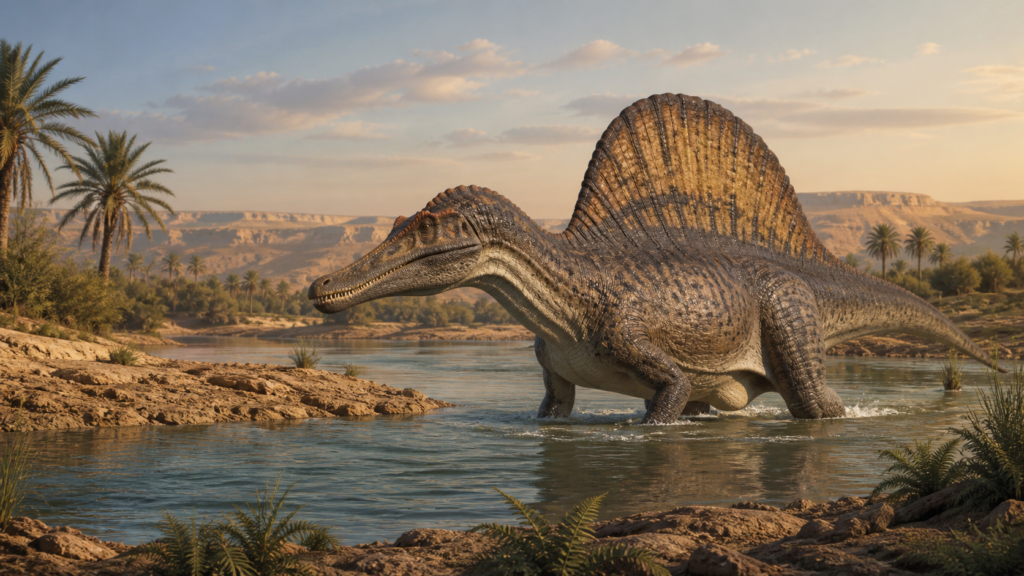
The most memorable feature of Spinosaurus mirabilis is its enormous cranial crest. It is described as scimitar-shaped, meaning that it curves like a short sword or sweeping blade. That shape is visually different from the skull profiles most people associate with the better-known Spinosaurus aegyptiacus.
The crest is not just a decorative detail for an illustration. Its surface texture and internal vascular canals were interpreted by the research team as evidence that it may have carried a keratinous sheath in life. Keratin is the tough material found in structures such as claws, beaks, and horns. If the crest was sheathed, its visible outline could have been larger and more colorful than the exposed bone alone suggests.
That interpretation makes display a plausible function. A bright, blade-like crest could have helped members of the same species recognize one another in a visually complex river forest. It might also have played a role in courtship or social signaling. These are hypotheses, not direct observations: fossil bones cannot record color or behavior with complete certainty.
Several Reddit discussions focused on exactly this feature. Readers described the crest as the “coolest” or most striking part of the animal, while others debated whether artistic reconstructions had made it too tall, too thin, or too colorful. Those reactions reveal why the crest is valuable for communication: it gives viewers a concrete anatomical difference to compare. For accuracy, however, artwork should separate what is preserved from what is reconstructed.
A useful caption therefore does more than repeat the dinosaur’s name. It should explain whether the image shows a fossil, a skull reconstruction, or a paleoart scene. That distinction helps readers understand the evidence and gives search engines clearer context about the image.
Why an inland river Spinosaurus changes the story
Spinosaurus mirabilis is valuable because it connects a recognizable animal to a specific ancient environment.
The discovery’s biggest scientific message may be geographic. The fossil locality in Niger was far inland—roughly 500 to 1,000 kilometers from the nearest ancient marine shoreline cited in the report. That distance matters because many earlier discussions of spinosaurids were shaped by fossils found in coastal or near-coastal deposits.
Coastal fossils can encourage one interpretation of an animal’s lifestyle. If a large fish-eating dinosaur repeatedly appears alongside marine or estuarine deposits, it is reasonable to ask whether it spent much of its time in water. But an inland river animal provides a different ecological test. It shows that a spinosaurid could occupy a river system far from the sea, where shallow channels, floodplains, and forested banks supplied food and shelter.
The report describes Spinosaurus mirabilis as an animal that probably lived in a forested inland habitat cut by rivers. In that setting, the river was not just a place to swim. It was a complete ecosystem: a source of fish, a route through the landscape, a drinking place for other animals, and a zone where a predator could wait for prey.
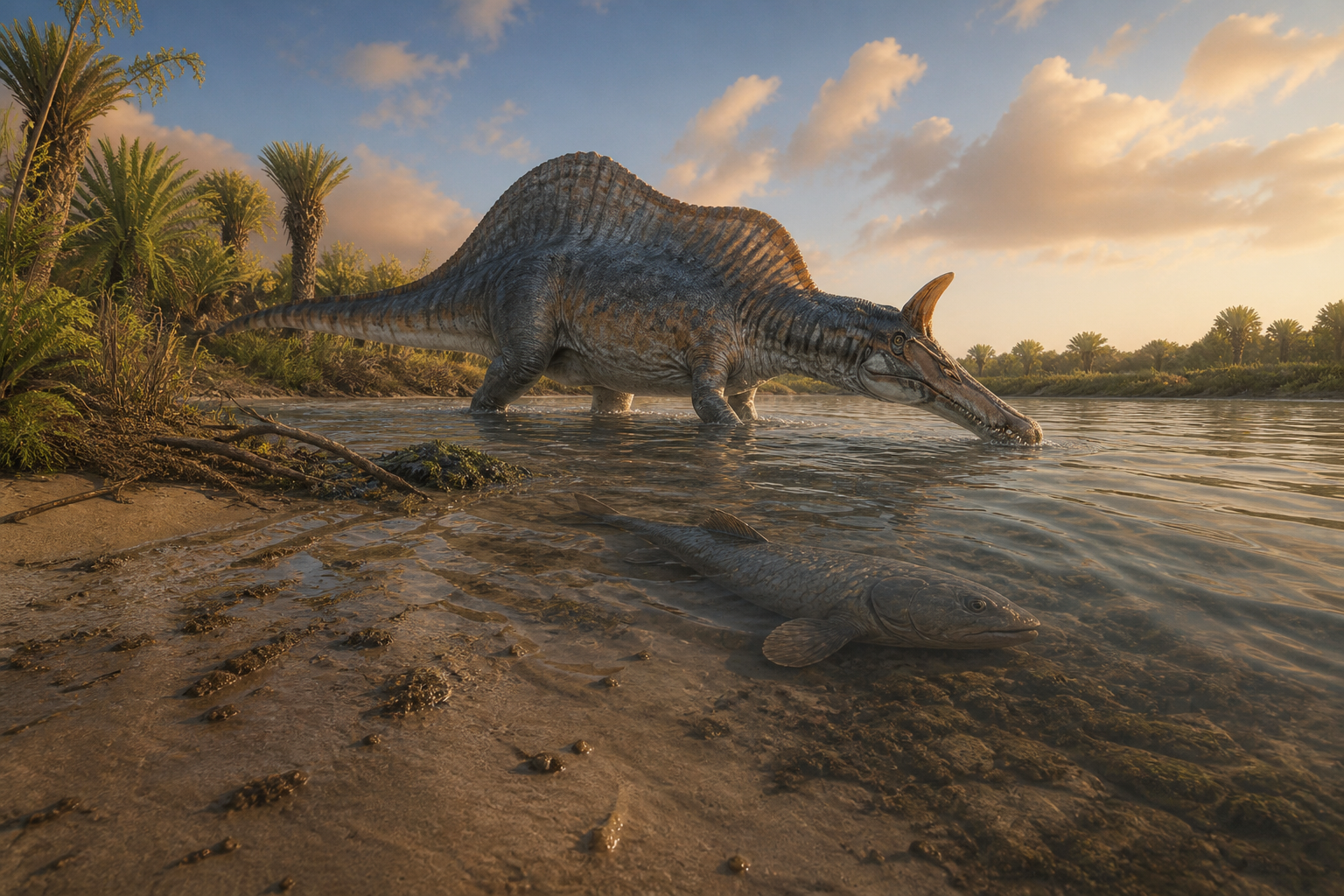
This is why the new species should not be reduced to a headline saying that another giant dinosaur “lived in water.” The more precise conclusion is that its fossils document a spinosaurid living in an inland river landscape. That evidence helps broaden the range of habitats considered when scientists reconstruct spinosaurid behavior.
Was Spinosaurus mirabilis fully aquatic?
The aquatic question is central to why Spinosaurus mirabilis has attracted so much attention beyond the initial fossil announcement.
Probably not, at least not based on the interpretation summarized by Sci.News. The report presents a wading and shallow-water picture rather than a crocodile-like deep-diving lifestyle. Paul Sereno’s description compares the animal to a large heron that could enter water but would spend much of its time stalking fish in shallower places.
The distinction between “aquatic,” “semi-aquatic,” and “water-associated” is important. A predator can rely heavily on fish without being a specialized underwater swimmer. Modern herons, storks, bears, and many other animals feed in water while still spending most of their lives on land. The same broad ecological pattern could apply to some spinosaurids.
Reddit readers repeatedly asked whether this discovery settles the Spinosaurus swimming debate. It does not settle every question. One species from one inland setting cannot automatically determine the behavior of every spinosaurid, and fossil evidence is incomplete. What it does provide is a new comparison: a fish-eating spinosaurid with unusual skull anatomy living in a river environment far from the coast.
The safest language is therefore evidence-based. We can say that the reported reconstruction favors wading, shallow-water hunting, and river-margin activity. We should not state as fact that the animal never swam, never entered deep water, or behaved exactly like a modern bird. Those details remain interpretive.
What makes this a new Spinosaurus species?
The formal diagnosis of Spinosaurus mirabilis gives readers a useful case study in how paleontologists distinguish a new species from a new genus.
One of the most thoughtful questions raised in Reddit’s paleontology community was: why is this a new species of Spinosaurus rather than a completely new genus? It is a fair question because the crest is so unusual and because the skull appears different from popular reconstructions of S. aegyptiacus.
Taxonomy is not based on whether an animal looks dramatic to the public. Researchers compare a set of anatomical characters, evaluate how those characters vary, and place the fossils into a broader evolutionary analysis. A new species can be recognized within an existing genus when the evidence supports a close relationship but also shows a consistent diagnostic combination that distinguishes the animal from its relatives.
In the case of Spinosaurus mirabilis, the reported combination includes the scimitar-shaped cranial crest and associated skull material, together with the broader body and habitat evidence discussed by the authors. The formal name reflects the study’s conclusion. Future work can test that conclusion with additional fossils and new analyses, as is normal in paleontology.
This is also where headlines can become misleading. “New species” does not mean that every question is solved, and it does not mean that the animal must be completely unrelated to other Spinosaurus. A good headline should create curiosity while preserving the distinction between a new species and a new genus.
The questions Reddit readers keep asking
Reddit conversations about Spinosaurus mirabilis are lively, but their best value for this article is showing which scientific questions readers want answered.
Reddit is not a peer-reviewed source, but public discussions can reveal which parts of a discovery readers find confusing. In several dinosaur and paleontology threads, the same themes appeared again and again: the unusual crest, the animal’s size, its relationship to S. aegyptiacus, and whether the fossil evidence really supports an inland lifestyle.
“How big was it?”
Size claims deserve caution. Some comments repeated a dramatic number as though it described the animal’s height, while other commenters correctly pointed out that a large theropod’s length and standing height are very different measurements. A dinosaur can be many meters long without standing that many meters tall. This is an excellent example of why an SEO headline should not repeat a viral number unless the measurement and source are clear.
“Does the crest make it a unicorn dinosaur?”
That phrase is memorable and appeared as playful shorthand in online reactions, but it should remain a metaphor. The evidence describes a scimitar-shaped crest, not a horned mammal-like unicorn structure. Using the more precise anatomical phrase in the headline and explaining the playful comparison in the body gives readers both clarity and personality.
“Is it replacing the classic Spinosaurus?”
No. A new species does not erase S. aegyptiacus. The two names represent different scientific hypotheses about related animals. Reddit readers often compared the new species with the familiar one, especially when discussing skull shape and body proportions. That comparison is useful as long as it does not turn into a simple winner-versus-loser story.
“Why does the inland location matter?”
This question is the strongest editorial angle. The location connects anatomy to ecology. Instead of treating the crest as an isolated novelty, readers can understand how the skull, river habitat, fish diet, and wading interpretation fit together. That is the central narrative of this article and the reason the discovery matters beyond its striking appearance.
For transparency, the online discussions used here are linked as examples of audience questions, not as evidence for the fossil interpretation. Readers should consult the published Science paper and the Sci.News report for the scientific account.
What we know—and what remains uncertain
Spinosaurus mirabilis is a strong reminder that a fossil discovery can be both scientifically important and honestly incomplete.
We know that a new species named Spinosaurus mirabilis was reported from Niger, that the fossils date to approximately 95 million years ago, and that the animal had a distinctive scimitar-shaped cranial crest. We also know that the locality was an inland river environment far from the ancient shoreline described in the report.
We have a reasoned interpretation of the crest’s possible keratin covering and display function, but we do not have a preserved color chart or a behavioral recording. We have a habitat-based argument for wading and shallow-water hunting, but not a complete movie of the animal’s daily movements. We have a formal species name, but taxonomy can always be refined as new fossils appear.
That combination of confidence and uncertainty is not a weakness. It is how paleontology works. Bones provide evidence, researchers build testable reconstructions, and later discoveries can strengthen, modify, or challenge them. The most useful article is not the one that makes the boldest claim; it is the one that tells readers which parts are directly reported and which parts are interpretation.
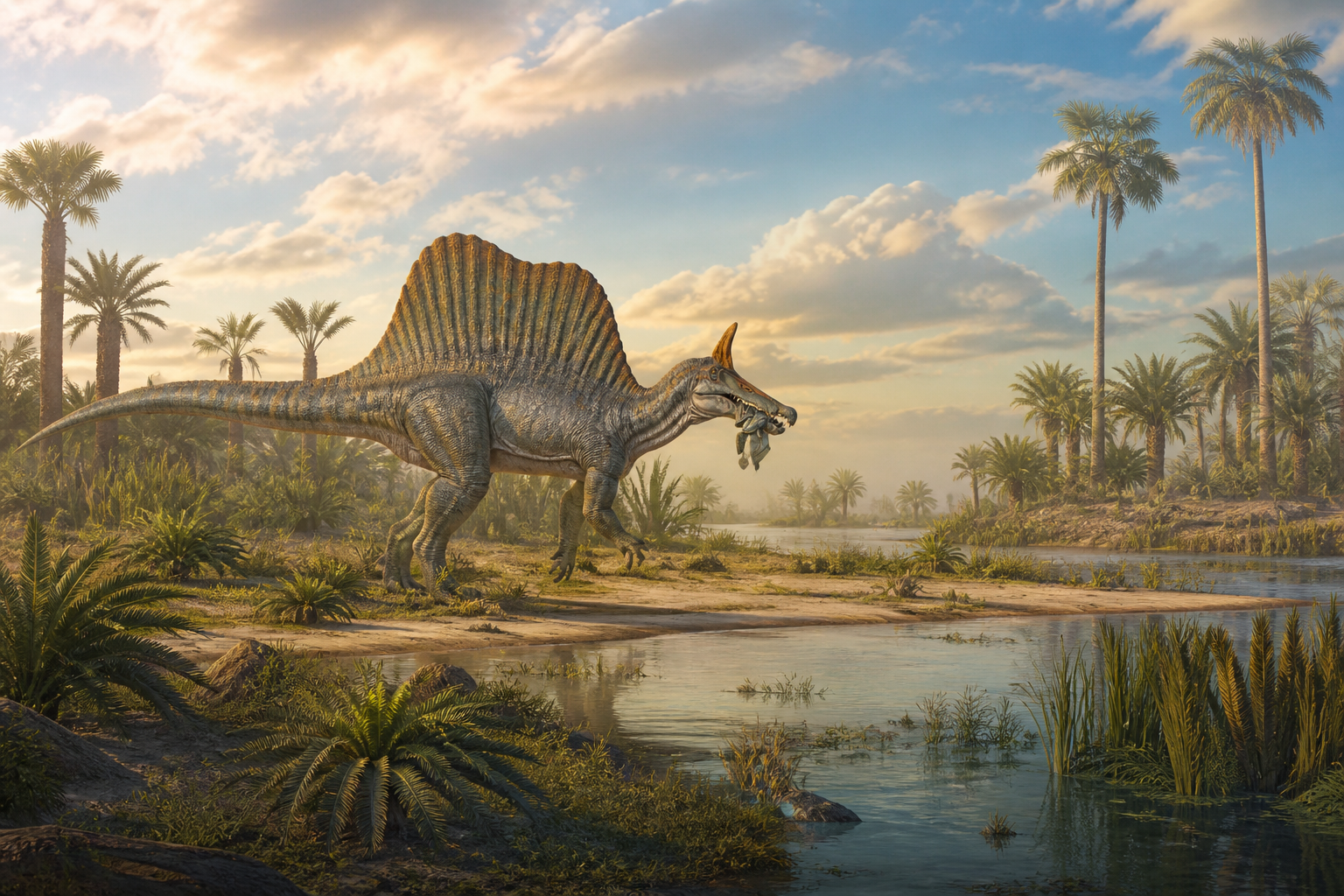
For fossil enthusiasts, the discovery also creates practical opportunities. New species often encourage museums, educators, and collectors to improve how they label specimens and reconstructions. A display should identify the specimen, distinguish original fossil from replica, and explain whether an image shows preserved anatomy or scientific reconstruction.
Frequently asked questions
These Spinosaurus mirabilis answers separate published evidence from the speculation that often spreads in online discussions.
What does the name Spinosaurus mirabilis mean?
The species name mirabilis is Latin for “wonderful” or “astonishing.” It fits the unusual crest, but the formal name should still be treated as a scientific designation rather than a claim that every reconstruction is certain.
Where was Spinosaurus mirabilis found?
The reported fossils came from the Jengueb fossil area in central Niger’s Sahara. The site represents an ancient inland environment with river systems and was far from the nearest ancient marine shoreline.
What did Spinosaurus mirabilis eat?
The available report presents it as a fish-eating spinosaurid. The proposed hunting setting was shallow river water and river margins containing large fish. That does not prove that fish were its only food or that it could not hunt on land.
Did Spinosaurus mirabilis swim?
The discovery supports a river-associated lifestyle, but “lived near water” is more precise than “was fully aquatic.” The interpretation summarized by Sci.News emphasizes wading and shallow-water stalking rather than a permanently submerged lifestyle.
How was it different from Spinosaurus aegyptiacus?
The most obvious reported difference is the massive scimitar-shaped cranial crest. Researchers also compare skull and other skeletal features when diagnosing the species. A full comparison should rely on the published anatomical analysis rather than simplified artwork.
Can I use the generated reconstruction as a fossil photograph?
No. The image in this article is an editorial reconstruction created to help readers visualize the habitat. It should be labeled as an illustration and should not be presented as an original fossil, museum specimen, or photograph of a living animal.
Conclusion: why this new Spinosaurus matters
Spinosaurus mirabilis deserves attention because its anatomy and inland setting open several research questions at once.
Spinosaurus mirabilis is memorable because it combines three powerful ideas: a new species, a spectacular crest, and an inland river habitat deep in what is now the Sahara. The crest gives scientists a striking anatomical feature to study. The Niger locality expands the ecological map of spinosaurids. The wading interpretation adds nuance to a debate that is often reduced to “land dinosaur versus underwater dinosaur.”
The discovery is also a reminder to slow down when a headline becomes exciting. Check whether a measurement describes length or height. Separate a fossil from a reconstruction. Treat Reddit reactions as questions, not evidence. Then return to the published research and ask what the bones actually support.
That approach makes the story more interesting, not less. The real mystery is not simply whether this dinosaur looked astonishing. It is how a distinctive spinosaurid lived in a river landscape, how its crest functioned, and what future fossils may reveal about the changing world of Cretaceous Africa.
If you would like to explore more fossil education and specimen displays, visit the Buy Fossils shop or browse the site’s main fossil collection. For the research behind this article, start with the Sci.News report on the new Niger species and the cited Science paper record.
Sources and further reading
Use these sources to continue researching Spinosaurus mirabilis after reading the article.
- Sci.News: New Spinosaurus Species Discovered in Niger
- Sereno et al., Science: New scimitar-crested Spinosaurus species from the Sahara
- University of Chicago: “Hell heron” dinosaur discovered in the central Sahara
- Reddit discussion: the Sereno spinosaur paper (audience questions and reactions)
- Reddit discussion: species versus genus (audience questions and reactions)
- Reddit discussion: size and aquatic-lifestyle claims (audience questions and corrections)